

This is the eleventh installment of my Service Management learning series. In our final session, we examined the case of a U.S.-based LCC (low-cost carrier). This company’s strategy comes down to one thing: absolute clarity about what to discard.
- 1 Winning Decisively by “Discarding”
- 2 What Is a Value Line?
- 3 They Didn’t Win Because They Were “Cheap”
- 4 A Textbook Example of the SPC in Action
- 5 Mapping Value Lines for Both You and Your Competitors
- 6 Applying “Strategy Is Choosing What Not to Do” in IT
- 7 Adapting to Environmental Change — Defending Core Strategy
- 8 Recommended Reading for This Session
- 9 Next Up
Winning Decisively by “Discarding”
This airline’s strategy is straightforward.
- Standardize on a single aircraft type to maximize maintenance efficiency
- Use smaller airports closer to city centers to reduce costs while improving convenience
- No in-flight meals, all-economy seating, no assigned seats
- Point-to-point direct routes to minimize turnaround time
In-flight meals, lounges, seat assignments — all the services that legacy carriers provide as “standard” have been completely discarded.
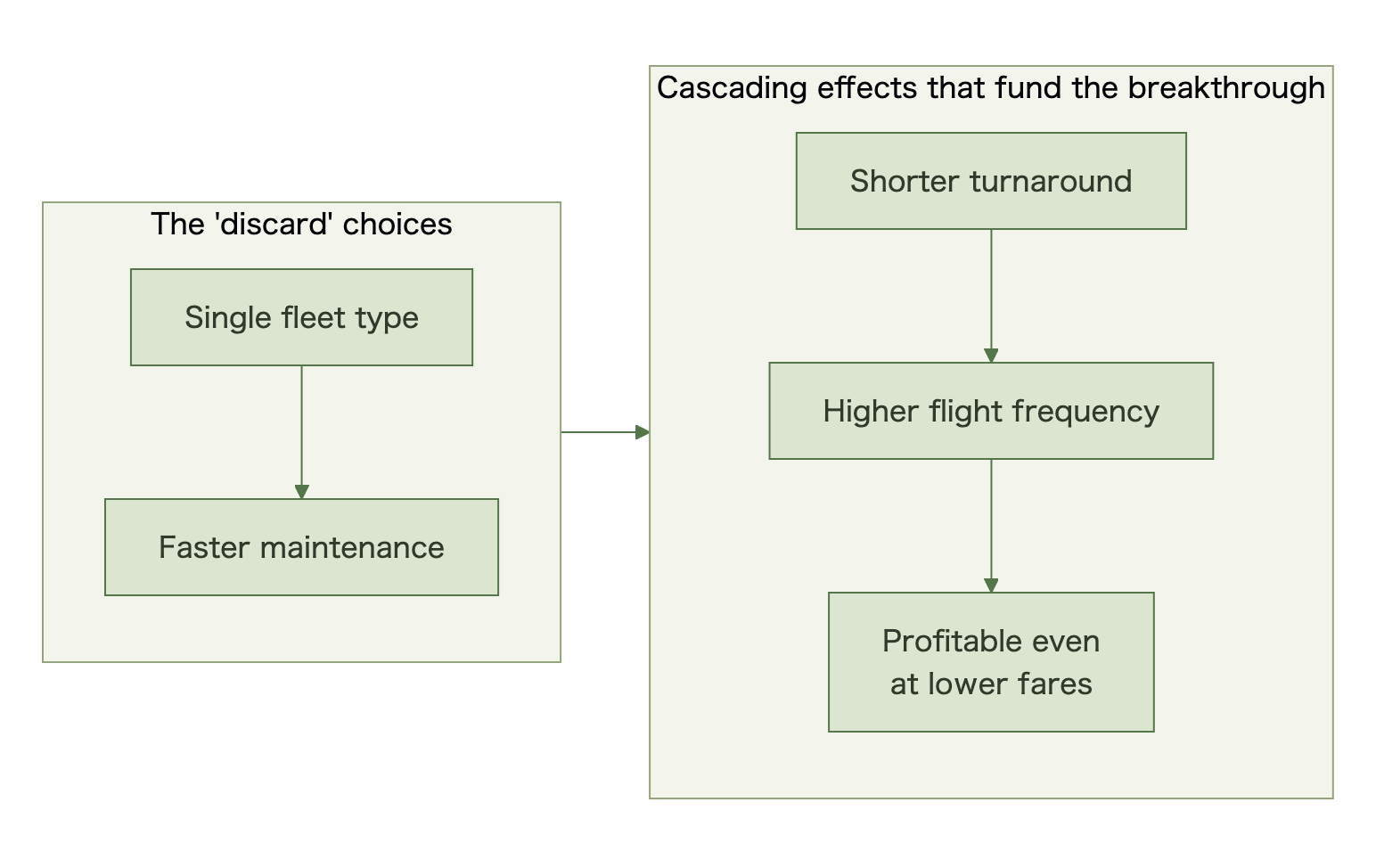
In their place, the airline overwhelmingly excels in low fares, high-frequency flights, friendly service, and on-time performance. Resources freed up by “discarding” are concentrated on the elements where the airline “breaks through.” What must not be overlooked is that the discarded elements and the retained elements are not independent. Standardizing aircraft types streamlines maintenance; faster maintenance enables shorter turnaround times; shorter turnarounds allow higher flight frequency; and higher frequency makes lower fares economically viable. The “discard” choices cascade through the entire cost structure, ultimately supporting the very elements where the airline breaks through.
What Is a Value Line?
The theoretical framework for this “strategic emphasis” is the value line concept.
Plot the various attributes of a service (price, convenience, comfort, customer service, food, etc.) along the horizontal axis, and the level of your company’s delivery on the vertical axis. Connect the dots, and you get a line graph. That’s the value line.
An average industry player delivers a moderate level across all attributes. The line is nearly flat. A superior service company’s value line, by contrast, has dramatic swings. Certain attributes are dramatically high while others are intentionally low — sharp peaks and deep valleys in the line.
When you plot this airline’s value line, it towers above the industry average in “price competitiveness,” “flight frequency,” “fun of the service experience,” and “on-time rate,” while falling well below average in “in-flight meals,” “seat comfort,” “lounges,” and “international network.” This extreme contrast is the strategy itself.
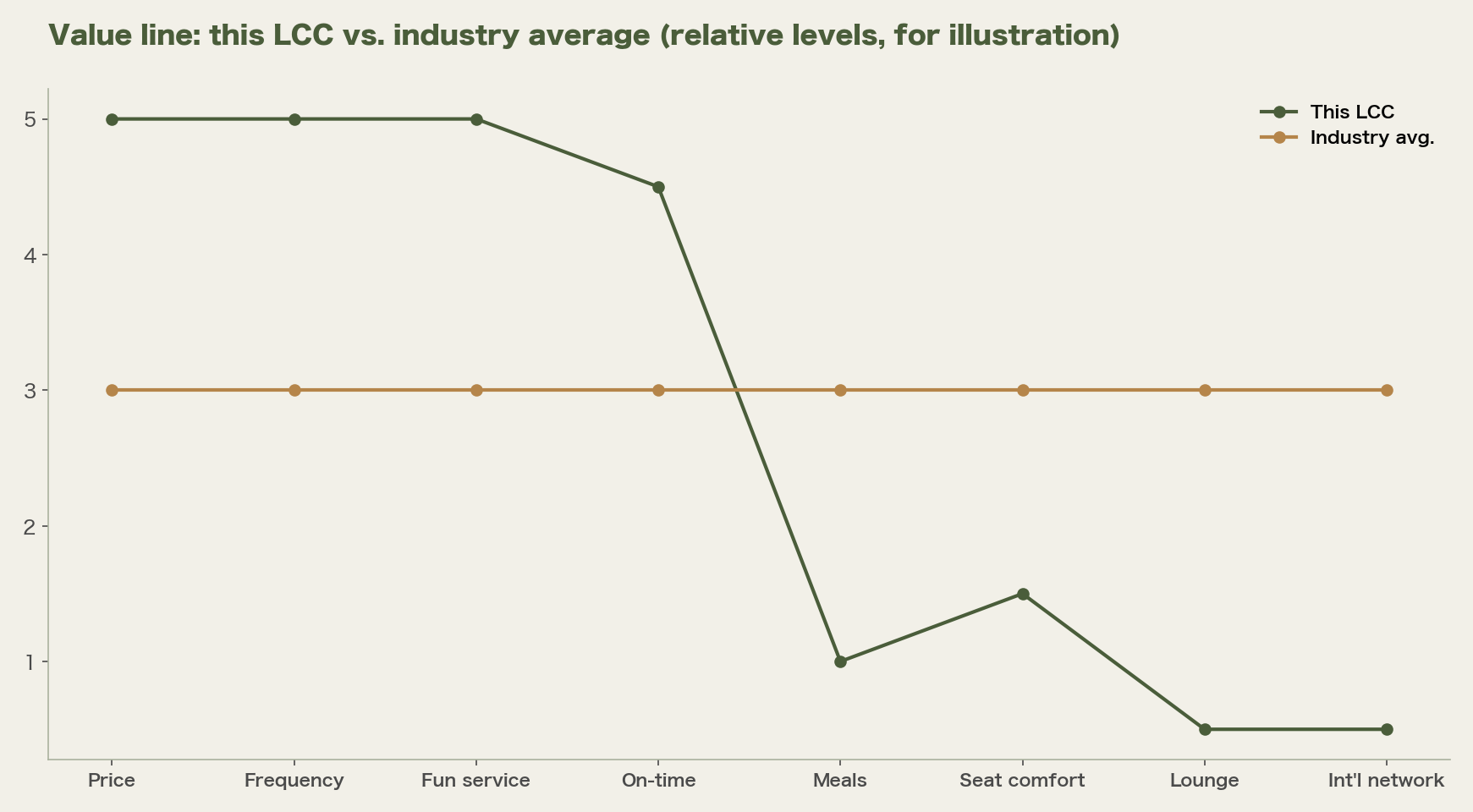
If you try to provide everything for everyone, all attributes settle at average — a “flat line.” That means “outstanding in nothing,” which is no differentiation at all. To customers, you become an unremarkable, “good enough but nothing special” option.
“The essence of strategy is choosing what not to do” — Michael Porter’s famous dictum. The value line is a framework that visually expresses this principle. As Porter pointed out, the essence of competitive strategy is “establishing a unique positioning,” which requires clearly deciding what you won’t do. Companies that try to do everything end up mediocre everywhere and strategically stuck.
They Didn’t Win Because They Were “Cheap”
An important caveat here: this airline didn’t win on “low price” alone.
An early-days episode discussed in the lecture was particularly memorable. While struggling with cash flow, a competitor launched a half-price fare war. The airline initially responded with its own price cuts, but this only led to a war of attrition.
The lesson learned: price cutting is the easiest strategy to imitate and leads straight to commoditization. Even if it looks like you’re winning through low prices, behind the scenes, employees are burning out and losing the ability to deliver the friendly service that was the airline’s true strength. Price wars are the surest way to destroy the SPC virtuous cycle.
The counterattack this company chose was to compete not on price but on “value.” Introduced in the lecture as the “whiskey maneuver,” this initiative offered a bottle of whiskey to customers who flew at full fare. At first glance, it looks like a simple promotional campaign, but there was deep strategic intent behind it.
First, it sent a message to both customers and employees: “We compete on fun and perceived value, not just cheapness.” Second, it made customers feel that “even at full fare, this experience is worth it,” effectively pulling the company out of the price war. Third, in an era before social media, this campaign spread by word of mouth and dramatically boosted brand awareness.
Ultimately, this company won not on price but on “value.” To be chosen even at full fare, a unique value proposition that makes customers think “for this price, this experience is worth it” is essential. Price can be imitated, but a service experience rooted in corporate culture cannot easily be replicated. That’s the source of sustainable competitive advantage.
A Textbook Example of the SPC in Action
The reason this airline appeared at the end of the series is that it’s a textbook example of the SPC working exactly as theory predicts.
A corporate culture built around “love.” Flight attendants who are friendly and take initiative. A marketing-oriented organization. All of these are manifestations of “internal service quality” — the starting point of the SPC.
Employees who visibly enjoy their work become part of the customer experience. The feeling that “this airline is somehow different” stems from the high level of employee engagement.
Interestingly, what this company prioritizes in hiring is “sense of humor” and “altruism.” Just like the hotel chain we studied previously, values matter more than skills in the hiring process. Though the industries differ, the principles of developing people for service excellence remain the same.
What’s especially notable is that this company positions employees as “internal customers.” Under the SPC framework, you first deliver the best possible service to employees, and that flows through to the best possible service for customers. This airline embodied that principle. Systems for incorporating employee voices into management decisions, a culture that respects frontline judgment, programs for employees to express gratitude to each other — these are mechanisms of “collaboration” and “creation,” not “control.” This is precisely why flight attendants have the latitude to improvise humor on board — creating a customer experience that competitors simply cannot replicate.
Mapping Value Lines for Both You and Your Competitors
A key practical application of the value line is to map not just your own line, but your competitors’ lines on the same graph. When you overlay your value line with a competitor’s, it immediately becomes clear “where you’re differentiated” and “where you overlap.”
For this airline, when you overlay its value line with a major full-service carrier’s, it loses significantly on “in-flight meals,” “seating,” and “lounges,” but wins decisively on “price,” “flight frequency,” and “staff friendliness.” What’s critical is that the attributes where it wins and where it loses constitute meaningful differentiation for the same customer segment. “Affordable, frequent flights with a fun experience” — for short-haul business trips and family travel, that’s not just adequate but actually more appealing than the legacy carriers.
Applying “Strategy Is Choosing What Not to Do” in IT
The value line concept applies directly to scope definition in IT projects.
If you try to accommodate every “I want this too, and that too” request from clients, you end up with a system where every feature is half-baked. Deciding “what not to build” maximizes project value.
The courage to say “let’s exclude this feature from the current scope” at the proposal stage — that is value line design. By concentrating resources on specific capabilities, you achieve overwhelming quality in those areas. That contributes far more to solving the customer’s problems than scoring average marks across the board.
As an IT delivery manager, this “decision to discard” is part of my daily work. Project resources are finite. If you try to build 100 features from 100 requests, every feature ends up at 60%. It’s far more impactful to narrow down to 20 features and aim for 100% on each. The value line framework transforms scope discussions from a negative “what do we cut?” conversation into a positive strategic discussion about “where do we break through?”
Adapting to Environmental Change — Defending Core Strategy
Another lesson from this airline’s case was the importance of defending your core strategy even when the environment changes.
After the September 11 attacks, stricter security checks caused on-time performance to drop. “If we extend turnaround time, on-time rates will improve” — but that would sacrifice the high utilization rate that was this company’s lifeline.
The conclusion from our discussion was that you must never destroy your core strategy to chase surface-level metrics. Adapt to environmental changes, but never lose sight of “what you refuse to discard.”
This is a judgment call that comes up frequently in the IT industry. Every time market trends shift, you hear “we should get into AI too,” “we should migrate to the cloud,” “we need to drive DX.” It’s not uncommon for companies to get buffeted by external forces and lose sight of their core competencies.
Adapting to environmental change is necessary. But that doesn’t mean abandoning your core strategy to chase the latest trend. Finding ways to adapt to environmental change while maintaining the “peaks” in your value line — that is strategic adaptation. This airline defended its core strategy of “low cost, high frequency, friendly service” even through the post-9/11 upheaval. Because it protected what needed protecting, it was able to soar again once the environment stabilized.
Recommended Reading for This Session
“高業績メーカーは『サービス』を売る” (High-Performing Manufacturers Sell “Service”) by Tetsuro Komori et al. (Diamond, Inc.) — a book that teaches value line design through case studies of manufacturers’ shift to service-oriented business. It provides concrete guidance on what to offer and what to discard in order to win on “value” rather than just “products.”


Next Up
Next is the final installment of the series. I’ll integrate the learnings from all 12 sessions and tackle the question: Why is Japan’s employee engagement among the lowest in the world? And how can the insights from Service Management be applied in practice?