

This is the third installment in my Service Management series. This time, I’m writing about what could be called the core framework of the entire course: the Service Profit Chain (SPC).
“Customer first.” Many companies rally behind this slogan, and it’s not wrong per se. But SPC leads to a counterintuitive conclusion: if you want to pursue customer satisfaction, start by investing in your employees.
- 1 What Is SPC? — A Seven-Link Causal Chain
- 2 Breaking Down Each Step of SPC
- 2.1 Step 1: Internal Service Quality → Employee Satisfaction
- 2.2 Step 2: Employee Satisfaction → Employee Loyalty
- 2.3 Step 3: Employee Loyalty → Employee Productivity
- 2.4 Step 4: Employee Productivity → Service Value
- 2.5 Step 5: Service Value → Customer Satisfaction
- 2.6 Step 6: Customer Satisfaction → Customer Loyalty
- 2.7 Step 7: Customer Loyalty → Profitability & Growth
- 3 The Importance of the “Sequence” SPC Reveals
- 4 Structural Parallels with the Balanced Scorecard (BSC)
- 5 SPC Through the Lens of IT Projects
- 6 Is SPC Universal? — The Platform Exception
- 7 Recommended Reading for This Session
- 8 Coming Up Next
What Is SPC? — A Seven-Link Causal Chain
The Service Profit Chain (SPC) is a model that maps out the causal relationships in a service business as a single connected chain. It was published in 1994 by Professor James Heskett and colleagues at Harvard Business School.
1994 — the very dawn of commercial internet use. In an era when management science was still centered on manufacturing, articulating the causal structure of services this clearly was groundbreaking. Until then, the prevailing view was that “service industries are a variant of manufacturing” and “service quality is inherently hard to manage.” By declaring that service businesses have their own distinct success principles, SPC became an epoch-making contribution to the field of Service Management.
The chain works like this:
Internal Service Quality → Employee Satisfaction → Employee Loyalty → Employee Productivity → Service Value → Customer Satisfaction → Customer Loyalty → Profitability & Growth
Seven causal links strung together. The key insight is that the chain starts with “internal service quality” — not with the customer, but with creating an environment where employees can do their best work.
Breaking Down Each Step of SPC
Let’s walk through each link.
Step 1: Internal Service Quality → Employee Satisfaction
“Internal service quality” refers to the foundation that supports employees in doing their work: the workplace environment, job design, training and development, compensation, and work tools. When these are robust, employee satisfaction naturally rises.
It’s important to understand what “internal service” really means here. This isn’t just about employee perks. It’s about how well the environment, tools, authority, and information that employees need to deliver value to customers are in place. For example: empowering frontline staff to offer discounts or additional services at their own discretion. Systems that give instant access to needed information. Training programs that support skill development. All of these fall under “internal service quality.”
In the IT industry, this translates to: Are you providing up-to-date development environments? Are testing environments adequate? Is documentation well-maintained? Are remote work systems in place? The quality of this “working infrastructure” directly affects engineer satisfaction. “I’m frustrated because we don’t have the right tools” is a state of low internal service quality.
Step 2: Employee Satisfaction → Employee Loyalty
Satisfied employees stay with the company. Turnover decreases, and experience and skills accumulate within the organization.
A caveat is needed here, though. “Satisfaction” and “loyalty” appear similar but differ. An employee satisfied with their salary might still leave if they see no career path ahead. Conversely, someone with slightly lower pay might stay if they feel “this company offers work I can’t do anywhere else.” Loyalty isn’t simply the accumulation of satisfaction — it arises from a genuine sense that belonging to this organization is meaningful. The original SPC paper defines employee loyalty not just as tenure, but as the strength of commitment to the company.
Step 3: Employee Loyalty → Employee Productivity
Employees who stay longer become more skilled at their work. They remember customer names, understand preferences, and can anticipate needs. The result is higher productivity.
This link is particularly crucial in service industries because service quality depends heavily on “accumulated human experience.” In manufacturing, mechanization and automation can achieve quality independent of individual experience. But in service industries — especially complex services — the gap between a veteran and a newcomer never fully closes. The composure a seasoned project manager shows during a crisis comes only from years of experience. This causal relationship of “experience accumulation → quality improvement” is what makes employee loyalty so valuable in service businesses.
Step 4: Employee Productivity → Service Value
Services delivered by skilled, experienced employees are higher quality. They create value that customers feel they “can only get here.”
In the SPC context, “service value” is defined as “benefits received by the customer ÷ costs borne by the customer (monetary + time + effort).” In other words, value can be enhanced not only by improving quality but also by reducing customer burden. For instance, even if a bank’s counter service quality stays the same, reducing wait time from 30 minutes to 5 minutes dramatically increases service value for the customer. In IT projects, even if deliverable quality is identical, making progress visible so the client spends less time on oversight increases the value they perceive.
Step 5: Service Value → Customer Satisfaction
This is where the “Expectation Disconfirmation Model” I discussed last time comes into play. When service value exceeds customer expectations, satisfaction is born; when it greatly exceeds them, delight follows. Conversely, no matter how skilled the employee, if customer expectations are even higher, dissatisfaction results. That’s why managing expectations alongside enhancing value is crucial.
Step 6: Customer Satisfaction → Customer Loyalty
As I detailed in the previous article, there’s a cliff between “4 (satisfied)” and “5 (delighted).” Mere satisfaction doesn’t translate to loyalty. Only when customers reach the delight level do loyalty behaviors — repeat purchases, referrals, cross-selling — emerge.
Step 7: Customer Loyalty → Profitability & Growth
The revenue impact of loyal customers is multifaceted: stable revenue from repeat purchases, new customer acquisition through word-of-mouth (at zero acquisition cost), higher tolerance for price increases, and additional service purchases. Research shows that a mere 5% improvement in customer retention can boost profits by 25-85%. The cost of acquiring new customers is said to be 5-7 times that of retaining existing ones — the economic case for a loyal customer base is overwhelming.
The Importance of the “Sequence” SPC Reveals
The impact of SPC lies not so much in the individual causal links but in making the sequence explicit.
Many companies say “let’s improve customer satisfaction.” But SPC teaches us that customer satisfaction is an outcome, not a starting point. The starting point is creating an environment where employees can thrive. Only after investing there does the chain begin to turn.
This isn’t about “pampering employees.” It’s about the management mechanism: investing in employees is the most efficient path to customer satisfaction and profitability.
Structural Parallels with the Balanced Scorecard (BSC)
SPC’s chain structure shares significant overlap with the four perspectives of the Balanced Scorecard (BSC). BSC organizes strategy through the causal flow of “Learning & Growth” → “Internal Business Processes” → “Customer” → “Financial.”
Comparing the two is revealing. SPC’s “Internal Service Quality → Employee Satisfaction → Employee Loyalty” corresponds to BSC’s “Learning & Growth” perspective. SPC’s “Employee Productivity → Service Value” aligns with “Internal Business Processes.” “Customer Satisfaction → Customer Loyalty” maps to the “Customer” perspective, and “Profitability & Growth” to the “Financial” perspective.
While BSC is a general-purpose management framework, SPC’s unique contribution is applying this causal structure specifically to service businesses with greater granularity. In particular, the concept of “internal service quality” and the three-stage breakdown of employee satisfaction, loyalty, and productivity offer a level of detail not found in BSC. For service business leaders, SPC translates more readily into concrete action than BSC does.
SPC Through the Lens of IT Projects
As someone who leads project teams at an IT vendor, I find SPC’s chain maps directly onto my reality.
Create an environment where team members can work with confidence (appropriate workload, clear role definitions, learning opportunities, psychological safety), and member satisfaction rises. Satisfied members stay on the team, and project-specific knowledge accumulates. Members with accumulated knowledge are more productive, and deliverable quality improves. High-quality deliverables lead to customer satisfaction, which leads to repeat engagements and new referrals.
Run it in reverse, and you push members to exhaustion, triggering turnover → quality decline → customer dissatisfaction → more pressure → more turnover — a death spiral.
I’ve seen this firsthand. On one project, two excellent engineers resigned in succession, and their replacements came onboard with inadequate handover. Quality dropped, customer complaints increased, and team morale plummeted further. It was the SPC chain running in reverse. Recovery required first reducing the remaining members’ workload, carving out time for training, and restoring “internal service quality” from the ground up. This happened before I knew about SPC, but looking back, the recovery steps we took were aligned with SPC principles almost by accident.
I had sensed these dynamics intuitively before learning SPC, but having it articulated as a framework clarified my team management priorities. Start with internal service quality.
Is SPC Universal? — The Platform Exception
SPC does have exceptions. In the lecture, we discussed a ride-sharing company case.
This company invested virtually nothing in driver training or development. Yet, through app convenience, upfront pricing, and a mutual rating system, user satisfaction remained high. “Low employee satisfaction yet high customer satisfaction” — a phenomenon that contradicts SPC’s thesis.
But this state didn’t last. When competitors emerged and drivers gained more options, a driver shortage became the bottleneck. The company was eventually forced to invest in employee satisfaction through measures like tipping systems — albeit belatedly.
You may be able to bypass SPC in the short term, but you can’t escape it long-term. That was the conclusion from the lecture. Technology may temporarily allow you to circumvent employee satisfaction, but once the market matures, competitors appear, and workers gain options, SPC’s principles reassert themselves like a gravitational force.
Recommended Reading for This Session
For those who want to dive deeper into the original thinking behind SPC, I’d recommend the following.
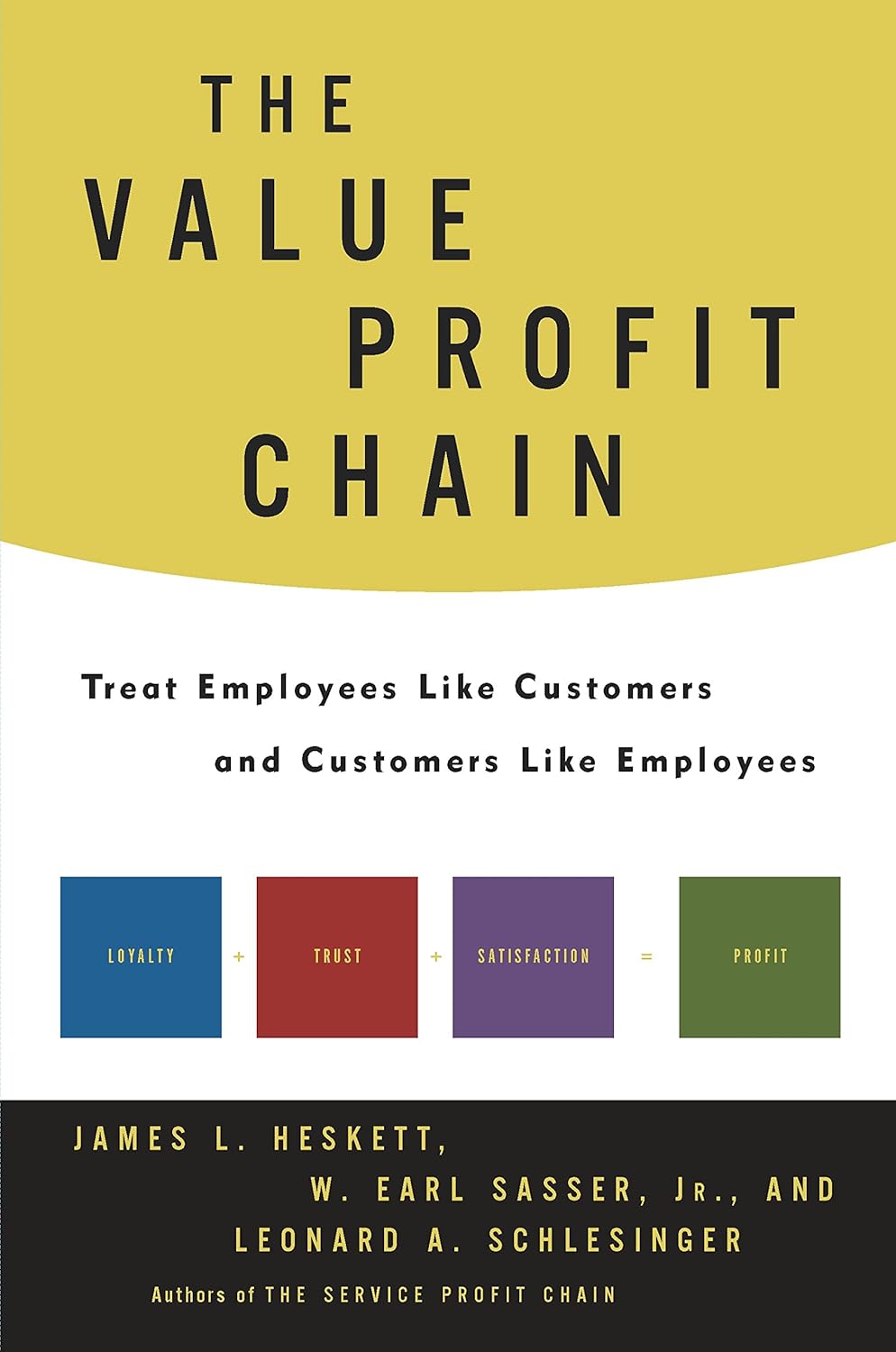
“The Value Profit Chain” (バリュー・プロフィット・チェーン) by James L. Heskett et al., originally published by Free Press — Written by Professor Heskett himself, the originator of SPC, this is the practitioner’s guide. After publishing the SPC theory, the authors examined how companies actually implemented the framework and what results they achieved, drawing on extensive case studies. It’s particularly rich in practical insights: how to measure the causal relationships at each link with data, and what to do when a specific link is weak. An essential read for anyone wanting to convert SPC “theory” into “management practice.”

Coming Up Next
We’ve covered SPC theory. But what happens when you actually implement it in an organization? Next time, I’ll explore the “virtuous cycle” that begins with employee satisfaction — and its opposite, the “vicious cycle” — through concrete case studies.