Why I Decided to Learn AI Now
I’ve been working in the IT industry for about 30 years — first as an infrastructure engineer managing servers and networks, and now as a delivery manager.
And yet, if someone asked me “What is AI, really?” — I honestly couldn’t give a clear answer.
AI is in the news every day. Talk of AI adoption is increasing at work. But “machine learning,” “deep learning,” “generative AI”… I knew the words, but how they related to each other — and how they actually get used in business — remained fuzzy in my mind.
Through my MBA program at a business school, I had the opportunity to study AI and data science systematically. My reasons were simple:
- I wanted to properly understand the foundations of AI
- I wanted to see how far my existing knowledge was from “the real basics”
- I wanted to grasp what AI adoption in business actually looks like
Many of my classmates came from non-IT backgrounds, so there wasn’t much anxiety about keeping up. What struck me more was looking at the curriculum. “XGBoost,” “AUC,” “confusion matrix”… unfamiliar terms everywhere. Can I really understand all of this? That excitement was bigger than any worry.
First Things First: What’s the Difference Between AI, ML, and DL?
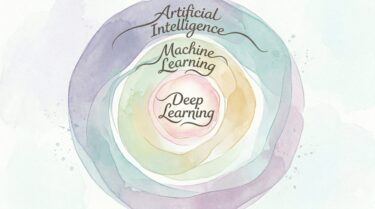
“AI,” “machine learning,” “deep learning.” They’re often used as if they mean the same thing — but they’re actually nested inside each other.
- AI (Artificial Intelligence): An umbrella term for technology that mimics human-like intelligence
- Machine Learning (ML): A subfield of AI that learns patterns from data using algorithms to make predictions
- Deep Learning (DL): One method within machine learning — the star of the current AI boom
Visually, it looks like this:
AI ⊃ Machine Learning ⊃ Deep LearningIn the media, “machine learning” and “AI” are often used interchangeably — but in a business context, machine learning sits at the core of data science.
One thing that clicked for me: regression analysis is also a form of machine learning. I’d always thought of it as a statistical method, but it shows up in machine learning too. Coming from an infrastructure background, I didn’t have many opportunities to connect these dots — so having them laid out clearly was refreshing.
Another thing that helped: thinking of generative AI (like ChatGPT) as separate from predictive AI. Generative AI ≠ Machine Learning (Predictive AI). They’re both called “AI,” but they’re pointing at different things.
“Statistics and Machine Learning Are Different” — This One Hit Home
One of the first “aha” moments in my learning was understanding this distinction.
Statistics and machine learning look similar on the surface — but their goals are completely different.
| Machine Learning | Statistics | |
|---|---|---|
| Goal | Prediction | Explanation (causality) |
| Business use | Implemented as a system | Basis for decision-making |
| Nature | Engineering-oriented | Science-oriented |
Statistics tries to answer “Why does this happen?” Machine learning is focused on “What will happen next?”
“The essence of machine learning is simply prediction.” This simple framing landed for me. A lot of the hype — and fear — around AI melted away once I understood this.
Using machine learning in business means predicting things like: “Will this customer buy?” “Will this loan default?” “Is this employee likely to quit?” — and building those predictions into a system. It’s not magic, and it’s not all-knowing. It’s a prediction tool. Once I saw it that way, it suddenly felt much more approachable.
I Experienced “Looking at Data” with the Titanic Dataset
My first hands-on exercise was Kaggle’s “Titanic” competition — a classic beginner data science challenge used around the world. The task: predict which passengers survived the Titanic disaster using passenger data.
It was my first time creating a Kaggle account.
The goal wasn’t to build a model — it was to understand the data. Using Excel pivot tables, I explored the passenger data (EDA — Exploratory Data Analysis) and thought through what factors might have influenced survival.
- Did women survive at higher rates than men?
- Did passenger class affect survival rates?
- Did age play a role?
Things you can’t see just by looking at raw data start to surface when you aggregate and visualize it. That was genuinely interesting.
And here’s what struck me: looking at data takes a lot more mental effort than I expected. AI conversations tend to focus on flashy algorithms — but “what data to look at, and how” is really the starting point. Getting hands-on made it clear just how critical the pre-modeling stage is.
Reflections and What Comes Next
The biggest thing I took away from this first phase of learning: my resolution on AI went up.
Even with 30 years in IT, there are things I never had the chance to learn systematically. AI was one of them. Words I vaguely knew started connecting into a structure that made sense.
Two things stood out most.
First: “The essence of machine learning is simply prediction.” This is a useful anchor. Both over-excitement and fear about AI start to settle when you come back to this.
Second: “Understanding your data is the foundation of everything.” Before models or algorithms, the ability to carefully examine data is what’s really being tested. And that feels true well beyond IT — it applies to business broadly.
Next up: hands-on practice building an actual prediction model using a data analysis tool. The challenge is predicting loan defaults using financial data. I’ll report back.
→ [Intro to ML #2 — coming soon]
Books That Helped Me Go Deeper
Learning about AI led me to pick up a few books. Here are two I’d recommend — especially before you start.
① To Grasp the Fundamentals of AI
Illustrated Guide to Machine Learning & Deep Learning (Gijutsu-Hyoronsha) — Japanese only


A visually rich introduction to how machine learning works. No programming knowledge required. Great for building an overall picture of AI before diving in.
② To Understand Machine Learning in a Business Context
Machine Learning for Business, 2nd Edition (O’Reilly Japan) — Japanese only

Less about code, more about how machine learning fits into business. A good read for business professionals thinking about practical application.