Tags: Approach S80, Garmin, Golf Watch, Release Date Prediction, 2026 Outlook, Approach J1
- 1 IntroductionMy Prediction Missed. So Let’s Be Honest About It.
- 2 Section 1Checking My December 2025 Predictions Against Reality
- 3 Section 2Why I Got It Wrong: Three Misreads
- 4 Section 3What Actually Happened at the January 2026 PGA Show
- 5 Section 4Three Strong Signals for Fall 2026
- 6 Section 5Predicted Evolution of the S80
- 7 Section 6Upgrade Strategy: A Decision Framework for April 2026
- 8 SummaryBuild Your Plan Around “Fall”
IntroductionMy Prediction Missed. So Let’s Be Honest About It.
In December 2025, I wrote on this blog that “the S80 is most likely to be announced at the January 2026 PGA Show.”
The result: no announcement.
As a data-driven blogger, I believe transparency about being wrong matters. But more than the miss itself, what matters is understanding why it happened.
In this article, I layer in new information available as of April 2026 — FCC filings, Garmin earnings call comments, and what actually happened at the PGA Show — to re-analyze the question: when will the S80 actually launch?
Section 1Checking My December 2025 Predictions Against Reality
Let me be straightforward about how my previous two articles held up.
| Category | My Prediction (Dec 2025) | Actual Result (Apr 2026) | Verdict |
|---|---|---|---|
| Announcement venue | S80 announced at PGA Show, Jan 20, 2026 | No S80 announcement | ❌ Miss |
| Launch timing | Japan launch: early February 2026 | No launch | ❌ Miss |
| PGA Show announcements | Did not anticipate any other releases | G82, J1, Home Tee Hero update announced | ⚠️ Partial miss |
| Release cycle read | ~3-year flagship cycle → H1 2026 | 3-year cycle still valid, but H2 not H1 | 🔺 Direction correct |
| Magnetic rotating crown | Expected based on Nov 2025 patent | New device confirmed via FCC; structural details undisclosed | 🔺 Still likely |
| AMOLED + solar | Predicted for standard model | Related patents secured; prediction continues | 🔺 Still likely |
| AI caddie evolution | Biometrics integration expected | Aligns with Garmin Connect+ roadmap | 🔺 Still likely |
| US-Japan launch lag | Within 8–10 days | G82 and J1 both launched in Japan 16 days after US announcement (Feb 5) — slightly wider but broadly valid | ✅ Broadly accurate |
Key TakeawayThe “what” was wrong, but the “big picture” — that Garmin would make major moves in 2026 — held up, and the technical direction was not fundamentally off. What I missed was primarily the timing and the venue. The three misreads below explain why.
Section 2Why I Got It Wrong: Three Misreads
Misread ①: Overconfidence in the PGA Show Pattern
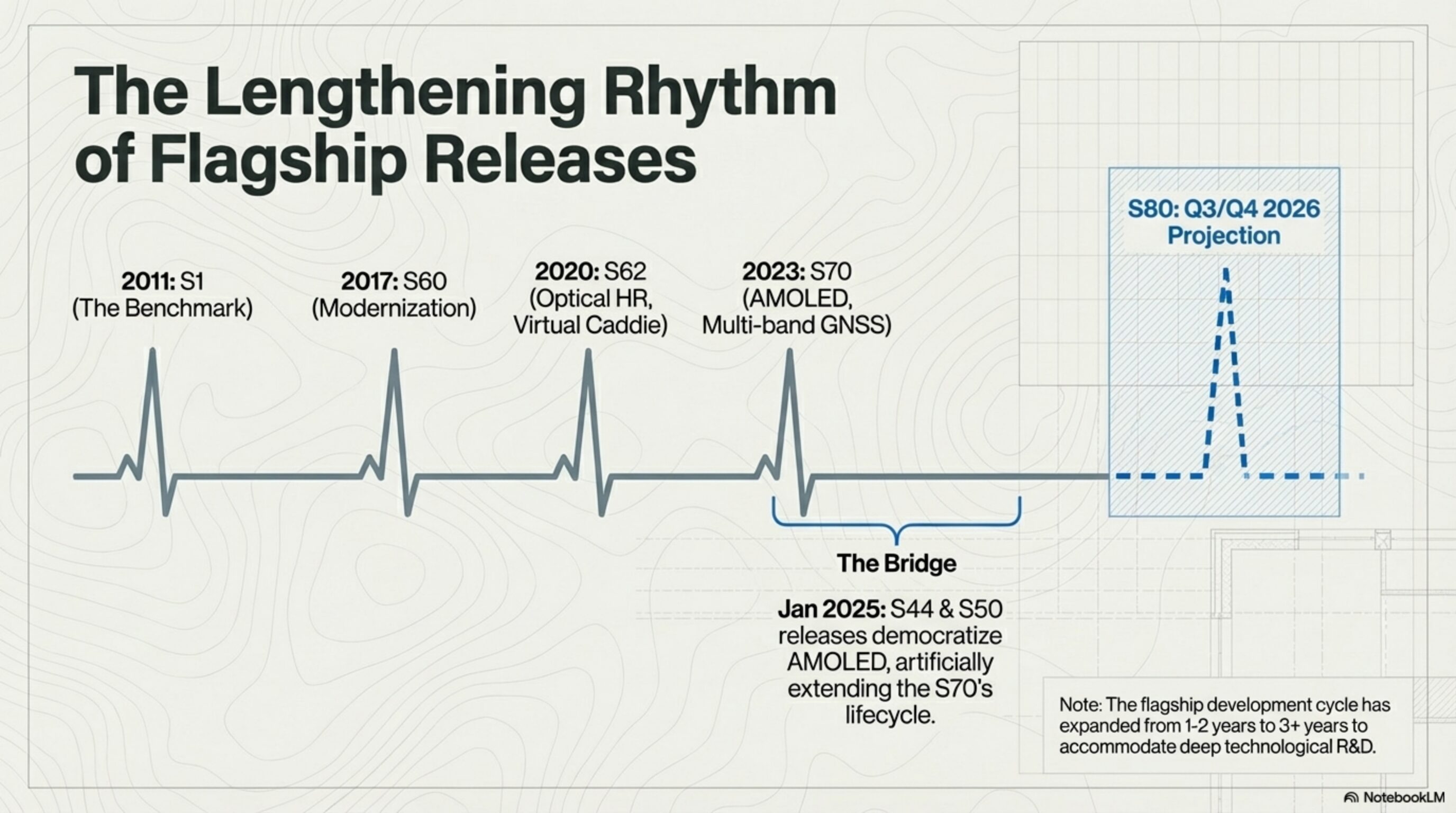
Because the S62 (January 2020) and the S50/S44 (January 2025) were both announced at PGA Shows, I assumed the flagship would follow the same rhythm. Looking back, though, the S70 was announced in May 2023 — not at a PGA Show at all. Garmin has a history of mid-year standalone press release launches. I mistook a two-instance pattern for a law.
Misread ②: Underestimating Supply Chain Headwinds
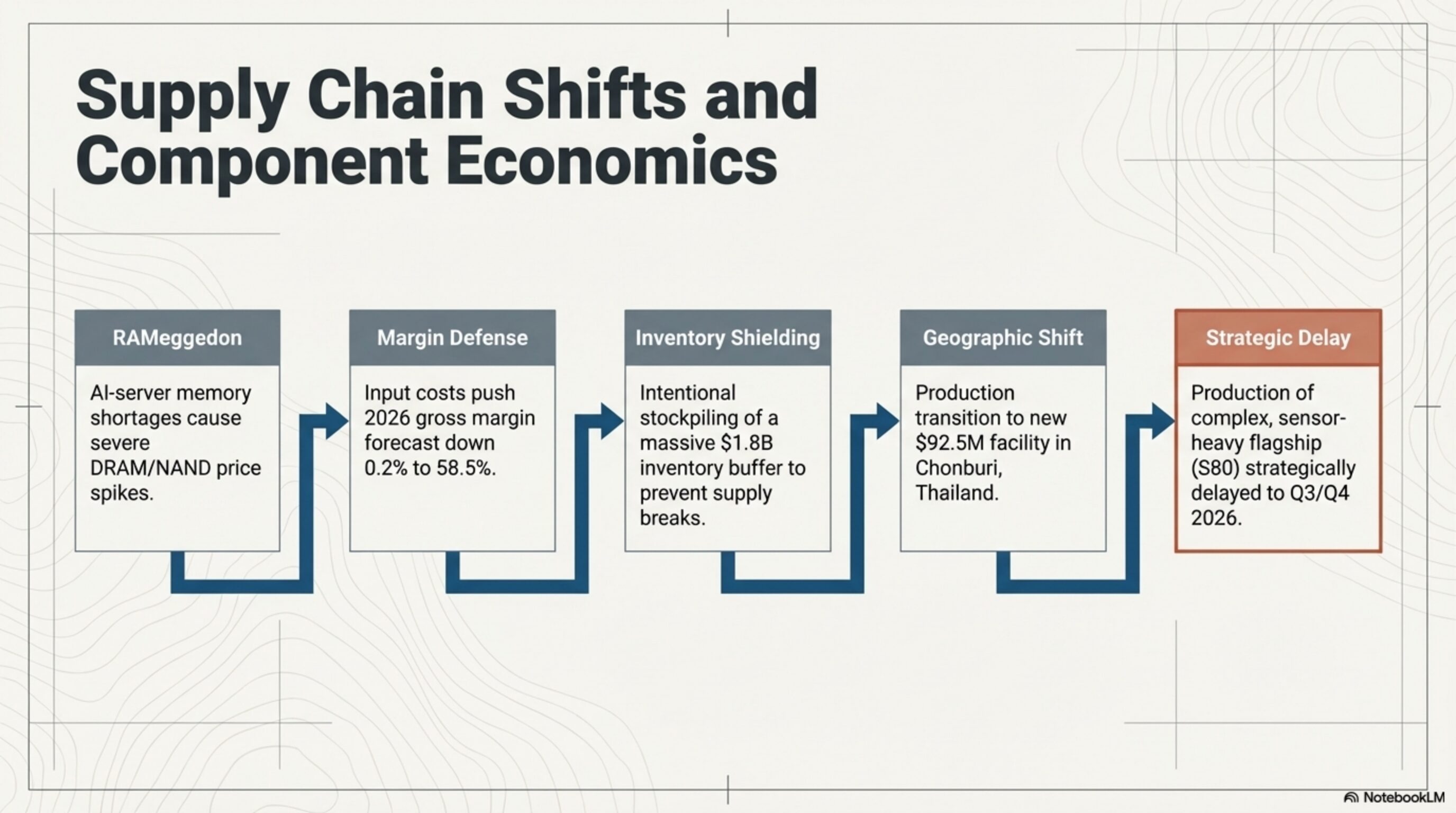
Between 2025 and 2026, AI server demand began consuming memory manufacturers’ production capacity, making it difficult for consumer electronics companies to secure components — a phenomenon now dubbed “RAMeggedon.” Garmin’s projected 2026 gross margin dipped 0.2% year-over-year, reflecting rising input costs from memory components. The company also built up approximately $1.8 billion in inventory by end of 2025 as a defensive buffer against supply disruptions. This was a rational backdrop for delaying a flagship launch — and I underweighted it.
Misread ③: Missing the Manufacturing Transition
Garmin is investing approximately $92.5 million to build its first Southeast Asian manufacturing facility in Chonburi, Thailand, targeting full operation in 2026. The plant is designed to manufacture smartwatches and GPS devices. It’s entirely reasonable that Garmin chose to delay flagship production until quality stability on the new line was confirmed. I underestimated both the strategic intent (geopolitical supply chain diversification) and the transition costs involved.
Section 3What Actually Happened at the January 2026 PGA Show
The S80 didn’t appear — but Garmin simultaneously expanded its ecosystem horizontally and vertically. Reading the absence of S80 as a failure misses the point. The more accurate read: a strategic placement to hold the S80 in reserve for the next quarter.
Approach G82: Redefining the Handheld
Announced January 20, 2026, the Approach G82 is the successor to the 2019 G80 and the largest golf handheld Garmin has ever made, featuring a 5-inch high-resolution color touchscreen. A powerful built-in magnet allows it to attach directly to a golf cart’s metal frame. It also introduces putting metrics for the first time in a handheld — measuring stroke length, tempo, and club head speed at impact. Priced at ¥95,800 (~$635) in Japan, it launched February 5, 2026.
Approach J1: Entering the Junior Market
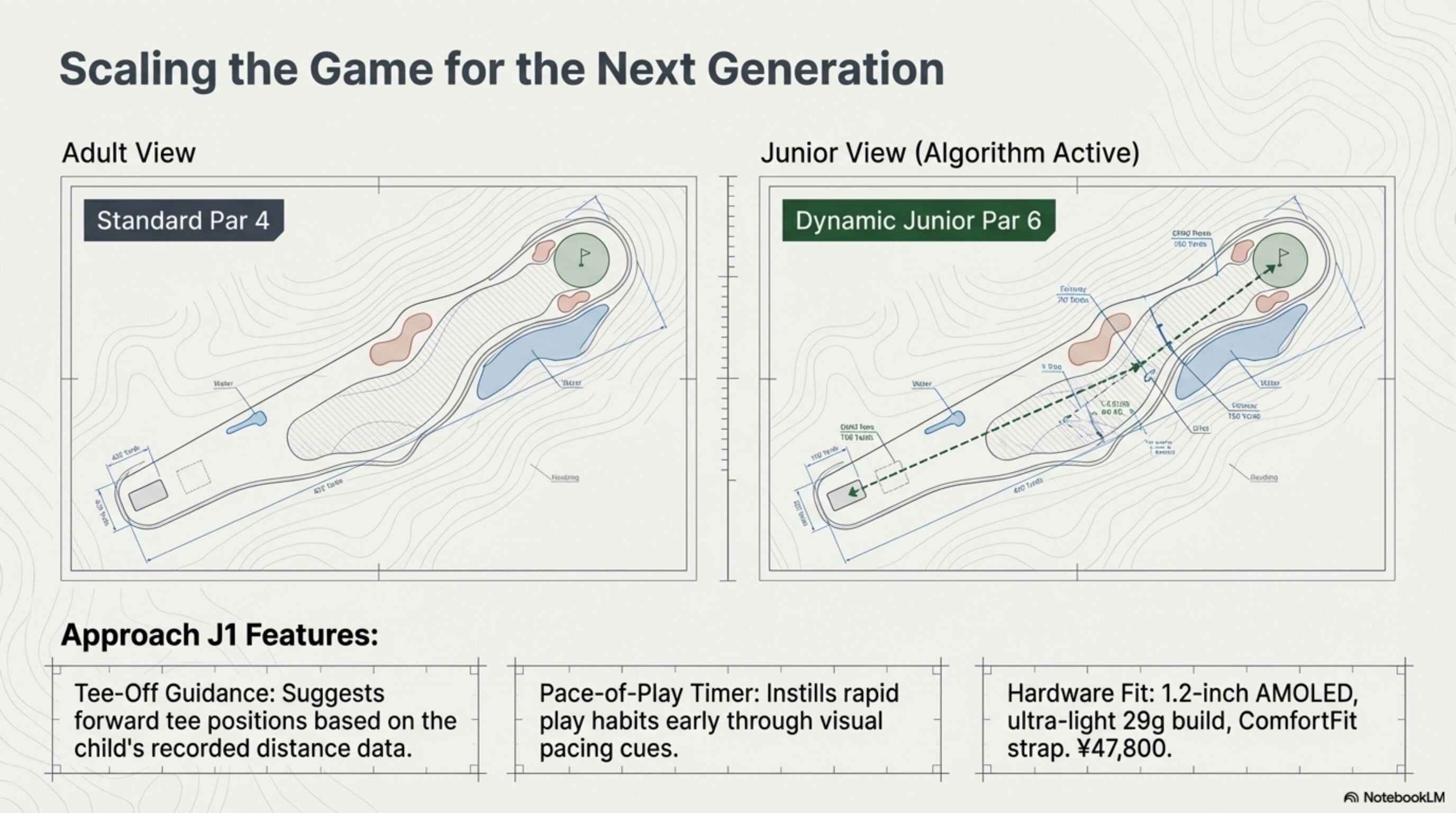
The Approach J1 is Garmin’s first GPS watch designed specifically for junior golfers. Two unique features — “Tee-Off Guidance” (recommending appropriate forward tee positions based on the player’s ability) and “Personal Par” (dynamically adjusting each hole’s par based on the player’s actual average score) — are designed to build a child’s sense of achievement. Priced at ¥47,800 (~$315) in Japan, it also launched February 5, 2026.
Why Junior, Why Now: The Deeper Strategy Behind J1
This is not a routine product line expansion. The J1 is a long-term strategic play Garmin is making in response to a structural crisis in the golf technology market.
Background ①: The Aging Golfer Problem — Garmin’s Core Customer Base Is Shrinking
In Japan, where Garmin’s golf business is particularly strong, the Sasakawa Sports Foundation’s 2024 survey estimates approximately 9.12 million golf participants (on-course and driving range), with participation rates of 14.8% for men and 3.0% for women. The numbers look healthy on the surface — but the age distribution tells a different story.
Japan’s golf courses face what analysts call the “2025 Problem”: the baby boomer generation, which forms the core of Garmin’s Approach user base (predominantly golfers in their 50s–70s), is aging out of active play. Garmin’s primary golf customers are structurally declining. This demographic risk isn’t unique to Japan — it mirrors trends in the US, UK, and Korea, where the median golfer age has risen steadily.
One bright spot: teen participation is surging. The post-COVID golf boom has been reaching younger players, and the data reflects it.
| Age Group | Golf Participation Rate (Male, Japan) | YoY Change |
|---|---|---|
| 70s | 15.5% | +0.7pt |
| 60s | 11.8% | ▲0.5pt (only decline) |
| 50s | 9.4% | +0.5pt |
| 30s | 9.0% | +2.9pt |
| Teens | 2.9% | Surge from near-zero |
The teen surge is the signal. The post-COVID golf boom is continuing into younger demographics, and Garmin moved to capture it.
Background ②: Maximizing Customer Lifetime Value (LTV)
A fundamental marketing principle: retaining an existing customer costs roughly one-fifth of acquiring a new one. Garmin consistently reports high retention rates and strong adjacent product attach rates. The J1’s strategic logic becomes clear when you think in decades:
J1
¥47,800 (~$315)
→
S44 / S50
¥44,800–67,800 (~$295–$445)
→
S70 / S80
¥100,000+ (~$660+)
→
Upgrade every 3 years
Tens of thousands over a lifetime
If a child starts at age 10 and stays with Garmin for 50 years, the lifetime spend adds up significantly. More importantly, the emotional bond formed with “the brand I started golf with” is something no Apple Watch — however capable — can easily displace. The J1 is a sub-$320 product that functions as the entry point to a decades-long customer relationship.
Background ③: Early Lock-In to the Garmin Connect Ecosystem
When a child buys the J1, they create a Garmin Connect account and begin accumulating scores, practice data, and round history in the cloud. Garmin is heavily invested in this ecosystem as its central hub for long-term retention. Data accumulation creates switching costs. Ten years of score history, club-by-club distance trends, and round records — the more these accumulate in Garmin Connect, the harder it becomes to switch to a competitor, psychologically and practically. J1 starts this process as early in life as possible.
The J1 in Three Time Horizons
| Time Horizon | Strategic Meaning of J1 |
|---|---|
| Short-term (2026) | A new product to fill the PGA Show announcement slot in the absence of the S80 |
| Mid-term (~2030) | Build an upgrade path: J1 → S44 → S50 → S70 → S80 as the player matures |
| Long-term (2040+) | Lock in Garmin Connect users from age 10–15, establishing 50-year customer relationships |
| Industry response | A proactive hedge against the structural risk of an aging, shrinking core golfer demographic |
My TakeAt weekend club events, I often see young kids playing golf alongside their parents — borrowing oversized clubs, barely reaching the fairway, but clearly loving every shot. The idea that those kids could have their own device collecting their own data from the start feels genuinely meaningful. Garmin saw this earlier than most.
Section 4Three Strong Signals for Fall 2026
Evidence 01
FCC Filing “A04378” — Confidentiality Expiration Date
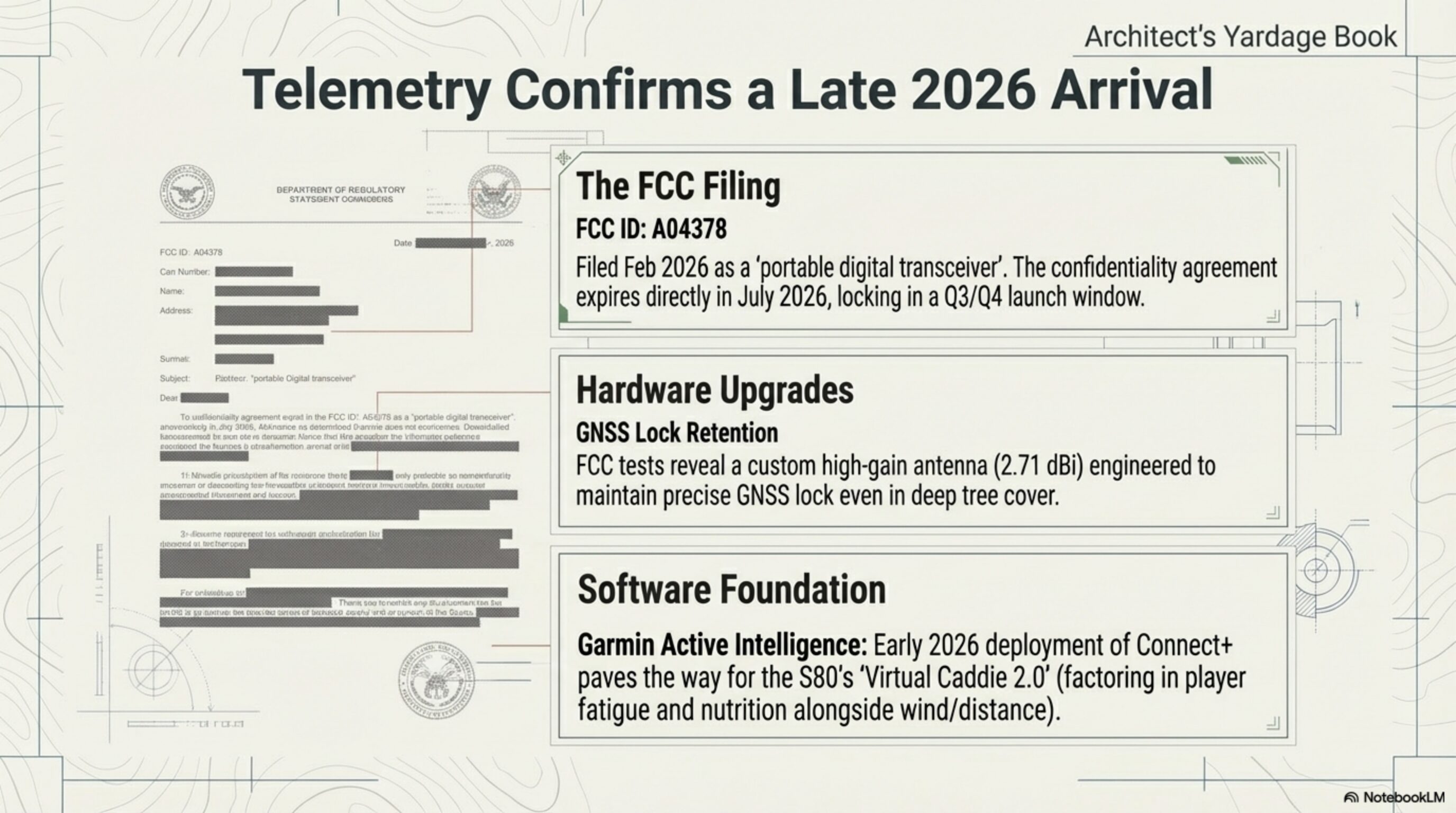
In February 2026, Garmin obtained FCC approval for a new wearable device under model number “A04378.” The confidentiality agreement included in the filing expires in July 2026, strongly implying that the official announcement and launch will occur after that date — i.e., in Q3 2026 or later. Given the typical 3–6 month lead time from FCC filing to product launch, and Garmin’s track record of a narrowing US-Japan gap (8–9 days for the S70 and S50/S44), September–October 2026 is the strongest candidate window.
Evidence 02
CFO Statement at Earnings Call
Garmin CFO Doug Boessen stated at the Q4 2025 earnings call that for the Outdoor segment in 2026, “the timing of new product introductions will make the second half of the year stronger.” There is no product in the Outdoor/Approach lineup capable of driving that kind of H2 acceleration other than a flagship. Explicitly flagging H2 to investors is a high-credibility signal.
Evidence 03
Historical Release Cycle
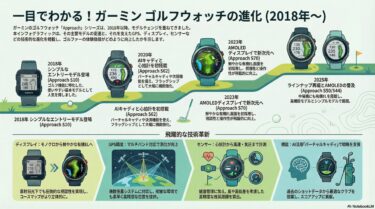
The flagship update intervals — S60 → S62 → S70 — have followed a roughly 3-year cadence, with the S62-to-S70 transition taking approximately 2 years and 8 months. With the S70 launching in May 2023, the statistical probability of a next-generation model in the second half of 2026 is high. All three signals converging gives me confidence in a September–October 2026 release window.
Section 5Predicted Evolution of the S80
High-Confidence Features
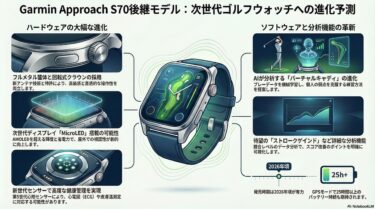
Display: AMOLED + Solar Charging
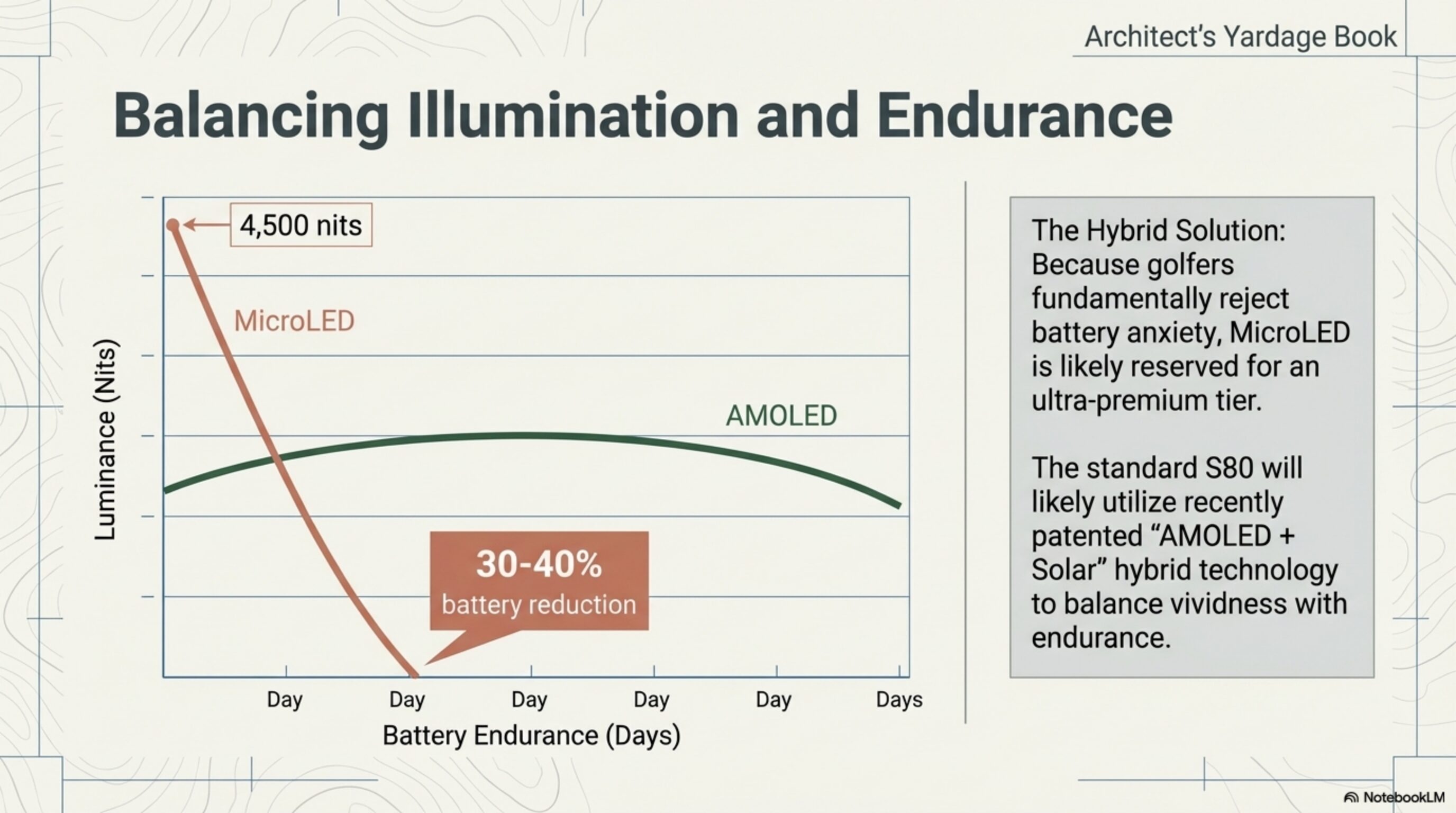
MicroLED offers exceptional brightness and no burn-in risk from inorganic materials — ideal characteristics in theory. But current MicroLED implementations reduce battery life by 30–40% vs. AMOLED and add approximately $700 to the price. Golfers are extremely averse to battery failure mid-round. It’s unlikely Garmin would sacrifice battery life for MicroLED across the board on the S80. The more probable strategy: deploy Garmin’s patented “AMOLED + solar charging” hybrid in the standard model, while reserving MicroLED for a potential premium variant.
| Technology | Peak Brightness | Burn-in Risk | Sunlight Readability | S80 Likelihood |
|---|---|---|---|---|
| AMOLED + Solar | ~2,000 nits | Present (organic material) | High | ✅ Standard model likely |
| MicroLED | 4,500 nits | None (inorganic) | Outstanding | 🔺 Premium variant possible |
| MIP (conventional) | Ambient light dependent | None | Best | ❌ Unlikely |
Sensor Upgrades
- Elevate Gen 5 or later optical heart rate monitor (improved accuracy and power efficiency)
- Skin temperature sensor for health monitoring and fatigue estimation
- Higher-precision blood oxygen saturation measurement
Interface
In addition to the standard 5-button layout, the patent-described magnetically-sensed rotating crown may appear. Its internally sealed design is intended to maintain waterproofing while improving usability when wearing gloves on the course.
Features I’m Hoping For
Integrated AI Caddie: Fatigue × Course Strategy
Reading the day’s condition from HRV (heart rate variability) status and incorporating it into course management recommendations — this is something I genuinely hope becomes real. The “Virtual Caddie 2.0” concept envisions club recommendations that factor in wind, elevation, historical shot data, and — crucially — fatigue and hydration levels.
What I Want to Hear“Par 3, 14th hole. Pin back right, 3 m/s headwind. Your HRV is below baseline today — you’re under more pressure than usual. Club up one, aim for the left-center of the green. That’s the shot that maximizes your success probability today.” That’s what a real caddie does. I think the S80 will start getting close.
Section 6Upgrade Strategy: A Decision Framework for April 2026
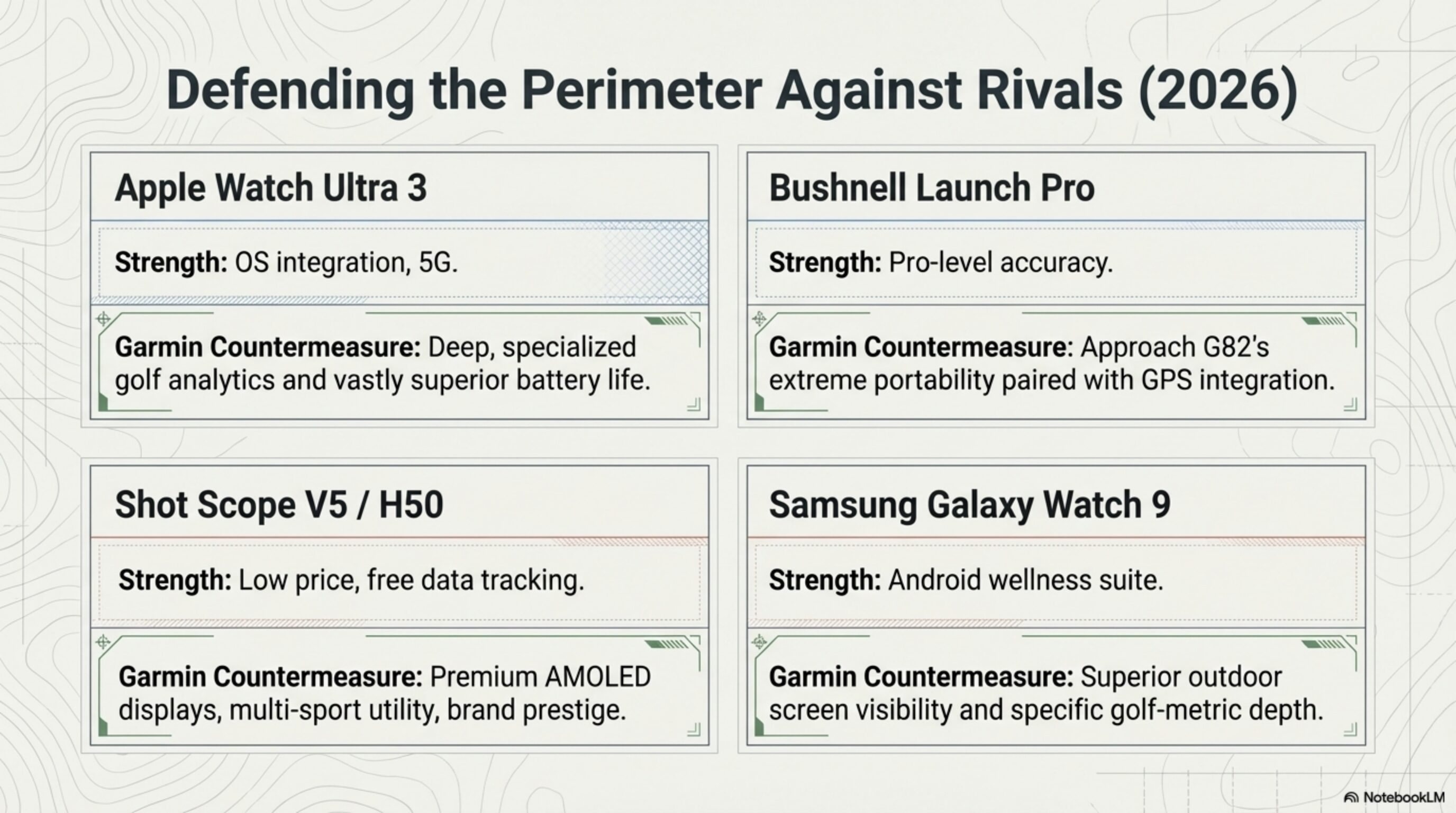
The situation has changed since my last article, so here’s the updated framework.
Case A
▶ Stay on Wait
If the S80 launches in Fall 2026, you’re 5–7 months away. No need to upgrade. That said, used and discounted S70 pricing will move the moment the S80 is announced — if you’re thinking of selling, now is the time to start keeping it in good condition.
Case B
▶ Look for used or discounted S50 as a bridge
The S80 is still one season away. Buying a new S50 at full price isn’t the best ROI at this point — but a used or clearance-priced S50 is a reasonable move. The AMOLED experience is a genuine improvement; the gap between S50 and S70 is smaller than it looks.
Case C
▶ Nothing to worry about
Enjoy the AMOLED experience. The S80 is your choice in 2–3 years.
Case D
▶ Decide based on use case — independent of the S80 timeline
The G82 is for golfers who want to go deeper on course management and shot analysis on a dedicated device. It’s a separate product axis from the S80. If you genuinely need launch monitor data today, there’s no reason to wait.
For Case B / Affiliate link (Japan)
For Case A (reference while waiting for the S80)
SummaryBuild Your Plan Around “Fall”
Approach S80 Forecast — April 2026
| Item | Forecast |
|---|---|
| Launch window | Q3–Q4 2026 (September–November most likely) |
| Key evidence | FCC confidentiality expiry (July 2026) + CFO “H2 acceleration” statement + historical release cycle |
| Japan launch lag | Within 10–16 days of US announcement (based on G82 and J1 precedent) |
| Announcement venue | Standalone press release more likely than PGA Show |
| Key upgrades | AMOLED + solar, magnetic rotating crown, Elevate Gen 5, deeper AI caddie |
| Expected price range | ¥10,000–20,000 (~$65–$130) above the S70 (~¥100,000) |
I was wrong when I wrote “PGA Show, January — that’s the day” in my last article. But being wrong gave me a valuable lesson: Garmin does not tie its flagship timing to the PGA Show.
The two highest-confidence signals I have right now: the FCC filing’s confidentiality expiry date, and the CFO’s explicit statement to investors that “the second half will be stronger.” Those are the anchors for this forecast.
For S70 users: hold a little longer. The upgrade coming this fall will be worth it. I’ll update this blog as new information emerges.